Find out if your music will be turned down by YouTube, Spotify, TIDAL, Apple Music and more. Discover your music's Loudness Penalty score, for free.
Your file will not be uploaded, stored or shared, meaning this process is secure and anonymous.
We all hate sudden changes in loudness - they're the #1 source of user complaints.
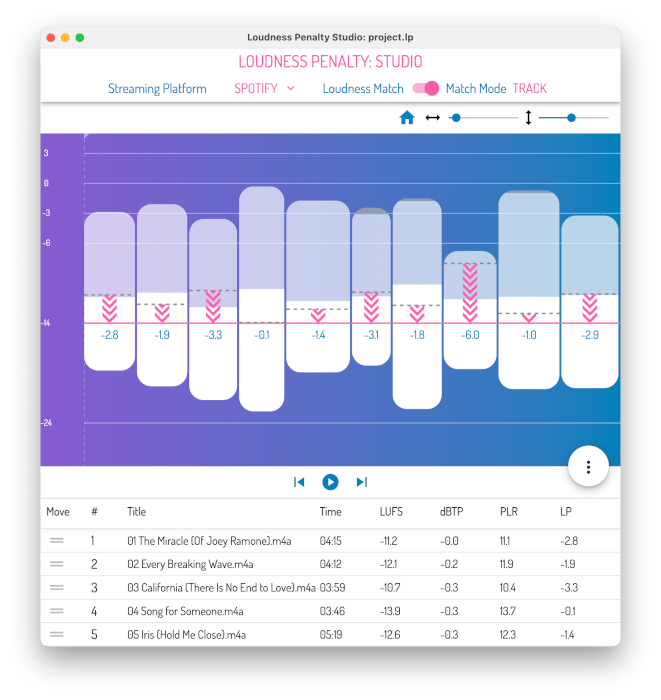
To avoid this and save us from being "blasted" unexpectedly, online streaming services measure loudness, and turn down music recorded at higher levels. We call this reduction the "Loudness Penalty" - the higher the level your music is mastered at, the bigger the penalty could be. But all the streaming services achieve this in different ways, and give different values, which makes it really hard to know how big the Loudness Penalty will be for your music...
Until now.
Simply select any WAV, MP3 or AAC file above, and within seconds we'll provide you with an accurate measurement of the Loudness Penalty for your music on many of the most popular music streaming services, and allow you to preview how it will sound for easy comparison with your favorite reference material.
Your file will not be uploaded, meaning this process is secure and anonymous.
Do you have any questions? Get in touch.
Find out how to optimize your music for impactful, punchy playback (and maximum encode quality) for all the online streaming services. Plus, receive a Loudness Penalty Report for your file that explains in detail what all the numbers mean.
Analyze another file: Services like Netflix and Disney+ solved accessibility issues but created a "paradox of choice".
: Research from the SAE Institute shows that comedies can physically lower blood pressure and decrease stress hormones.
Despite the shift to mobile screens, the physiological benefits of entertainment remain potent. teenporn movies
Looking ahead into 2026 and beyond, experts at Deloitte predict a move toward "Tech Media" where the line between gaming, social media, and film disappears.
: Traditional studios used to rely on "gut feeling" and creative risk; now, "Tech Media" companies use Big Data Analytics to predict what audiences will watch, often leading to "safe" franchise sequels rather than original stories. Why We Still Watch: The Psychology of Film : Services like Netflix and Disney+ solved accessibility
The landscape of movies and media has shifted from a rare luxury to an easily accessible commodity, but this "golden age" of content is currently facing a massive identity crisis. As of early 2026, the industry is grappling with the "death of the monoculture"—the idea that movies no longer reign as the primary form of visual storytelling because audiences are fragmented across endless streaming niche platforms. The Evolution of Choice: From "Events" to "Content"
2026 Media & Entertainment Industry Outlook | Deloitte Insights Looking ahead into 2026 and beyond, experts at
: One in three consumers now chooses a movie based solely on social media discussions. Platforms like Reddit and TikTok have created a "fear of missing out" (#FOMO) that drives ticket sales for viral hits, such as the massive cultural impact seen with the Barbie movie. The Future: Immersive and AI-Driven