Basics


Info Download

Advanced

v/v
V
V

Plot Download

The primary goal of this exercise is to teach students how to form descriptive word combinations and use them correctly within sentences containing homogeneous members and generalizing words.

: It encourages the use of synonyms to avoid repetition and enrich written language.

: This exercise is highly effective for 5th graders as it bridges the gap between simple word selection and complex sentence structure. It reinforces punctuation rules (the use of colons with generalizing words) while expanding the student's expressive toolkit. Summary of the Textbook Context

: Students are asked to create "adjective + noun" combinations using a specific set of synonyms provided in a reference box: udivitel'nyy (amazing), porazitel'nyy (striking), izumitel'nyy (wonderful), divnyy (marvelous), and chudesnyy (wonderful). Skill Development :

The reference refers to exercise 266 in the classic 5th-grade Russian language textbook authored by T.A. Ladyzhenskaya and others, published by Prosveshcheniye . This specific 2007 edition (the 34th) is a staple of Russian secondary education and focuses on fundamental grammar and syntax.

: The second part of the task requires constructing sentences where a generalizing word is followed by a list of homogeneous members (e.g., using a colon to separate the general category from the specific adjectives).

Review of Exercise 266 (Topic: Word Combinations and Homogeneous Terms)

This edition is part of a long-standing curriculum known for its methodical approach to Russian linguistics. While newer editions (post-2012) align with updated Federal State Educational Standards (FGOS), the 2007 version remains widely used by tutors and parents for its clear, traditional explanations of Russian grammar .
Disclaimer: This tool is provided for educational and illustrative purposes only. No guarantee is made regarding accuracy, suitability, or performance. Use at your own risk. - Copyright: ufelectronics.eu / Andreas Dyhrberg

×
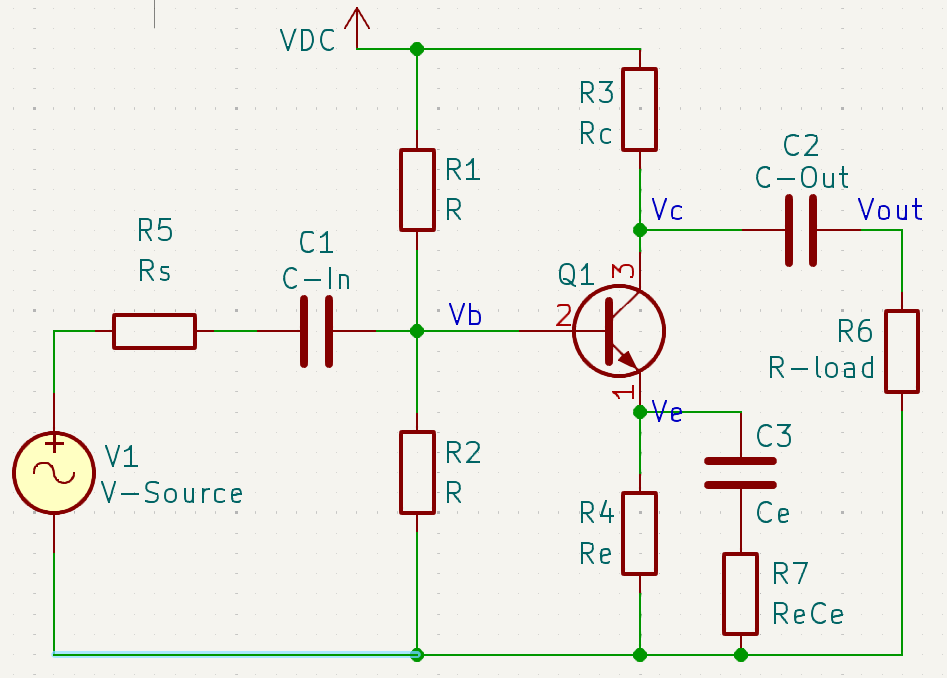
Amplifier Schematic
×

There are different ways to calculate an amplifier, depending on what you want to achieve.

Maybe you want to achieve a certain gain, as far as possible (classic mode). Or you have a low Vcc to respect (modern mode). Or you work with analog audio amps (symmetry mode).

Depending on what you want to achieve and the way of calculating it. Some fields might become dependent on others, or the other way around.

Your above choise makes some input fields available for manipulation, while hiding others.


🎯 1. Target Gain (Av) — "Classic mode" The primary goal of this exercise is to

You care about how much your amplifier multiplies the input signal.

Set desired voltage gain and Rc voltage drop. Best for learning and simple amplifiers.

You say: “I want a gain of 10.”
The app adjusts resistors to try and match that.
You must give Av and Vrc (the voltage dropped across Rc).

Best for common emitter amplifiers.

✅ Default choice for most beginners and educational use. It reinforces punctuation rules (the use of colons


⚡ 2. Target Emitter Voltage (Ve) — "Modern mode"

You care about setting a healthy DC bias point.

Prioritize stable biasing via Ve. Useful for low-voltage circuits or precision designs.

You say: “I want Ve = 0.5 V, to keep the transistor out of trouble.”
This makes sure your transistor stays in active mode.
Gain becomes whatever it turns out to be.

Ideal for common emitter amplifiers when the goal is to ensure proper biasing for low-voltage or precision circuits, and it’s also used in class AB amplifiers to prevent distortion Ladyzhenskaya and others, published by Prosveshcheniye

✅ Useful in low-voltage designs (e.g., 3.3V systems).


🧭 3. Target Collector Voltage (Vc) — "Symmetry mode"

You want to place the collector in the middle of the power rail.

Target Vc = Vcc/2 for maximum signal swing. Great for audio and analog signals.

You say: “Make Vc = Vcc/2” for maximum swing.
Useful for analog audio amps or symmetrical headroom.
Gain and Ve are outcomes.

Best for common collector amplifiers and class AB amplifiers.

✅ Best for signal integrity.

Russkii Iazyk 5 Klass Zadanie266 Moskva Prosveshchenie 2007 34-e Izdanie Direct

The primary goal of this exercise is to teach students how to form descriptive word combinations and use them correctly within sentences containing homogeneous members and generalizing words.

: It encourages the use of synonyms to avoid repetition and enrich written language.

: This exercise is highly effective for 5th graders as it bridges the gap between simple word selection and complex sentence structure. It reinforces punctuation rules (the use of colons with generalizing words) while expanding the student's expressive toolkit. Summary of the Textbook Context

: Students are asked to create "adjective + noun" combinations using a specific set of synonyms provided in a reference box: udivitel'nyy (amazing), porazitel'nyy (striking), izumitel'nyy (wonderful), divnyy (marvelous), and chudesnyy (wonderful). Skill Development :

The reference refers to exercise 266 in the classic 5th-grade Russian language textbook authored by T.A. Ladyzhenskaya and others, published by Prosveshcheniye . This specific 2007 edition (the 34th) is a staple of Russian secondary education and focuses on fundamental grammar and syntax.

: The second part of the task requires constructing sentences where a generalizing word is followed by a list of homogeneous members (e.g., using a colon to separate the general category from the specific adjectives).

Review of Exercise 266 (Topic: Word Combinations and Homogeneous Terms)

This edition is part of a long-standing curriculum known for its methodical approach to Russian linguistics. While newer editions (post-2012) align with updated Federal State Educational Standards (FGOS), the 2007 version remains widely used by tutors and parents for its clear, traditional explanations of Russian grammar .