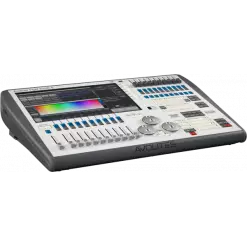
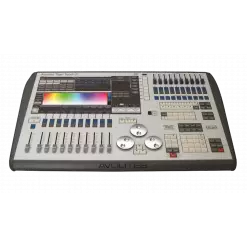
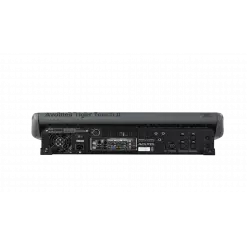
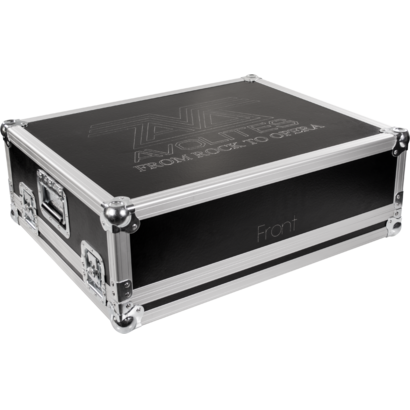
Now boasting a 100% brighter screen, increased processing power, and faster graphics engine, the Tiger Touch II is the most specified Titan console.
The Avolites Tiger Touch II represents the perfect combination of power and portability. This third-generation console is packed with enough power for complex shows, yet small and light enough to fly in standard hold luggage. The console features SMPTE timecode support and a redesigned button layout to match the entire Titan range.
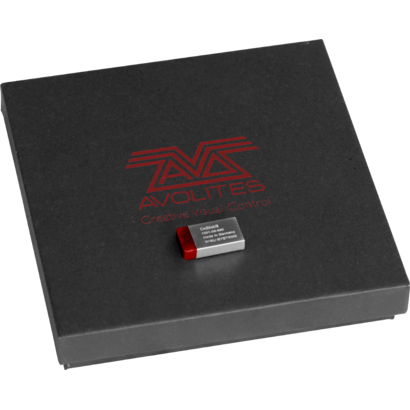
In order to update the console to version 12 of the Titan, it will be necessary to purchase and install a USB dongle called AVOKEY.
Serial 02006 - 03065
You need to order:
- AVOKEYINT
- 1x5 way to USB-A Cable (spare part code 8000-6102)
Once you've received your AVOKEYINT and 1x5 way to USB-A Cable, you will be required to connect the USB-A Cable to the motherboard. This cable will provide an additional USB port for the AvoKey.
Click here to view the installation guide: https://www.avolites.com/Portals/0/Downloads/Manuals/AvoKey/8000-6102 TT2-2-3K AVOKEY upgrade with 1808-0028.pdf
Serial 03066 - 4020
You need to order only AVOKEYINT
Once you've received your AVOKEYINT, you will be required to connect this directly to the available (Blue) USB port inside the console (on the motherboard).
Click here to view the installation guide: https://www.avolites.com/Portals/0/Downloads/Manuals/AvoKey/8000-6101 TT2 AVOKEY no cable.pdf
Serial 04021 - 05001
You need to order only AVOKEYINT
Once you've received your AVOKEYINT, you will be required to connect this directly to the available (Red) USB port inside the console (on the motherboard).
Serial 5001 and above include a factory fitted AvoKey.
Therefore, you do not need to purchase an AvoKey. Instruments.of.Destruction.v0.208b.zip
He pressed the forward key. The physics were hyper-realistic; he could practically feel the weight of the virtual machine shifting through his desk. Ahead of him, a massive, complex concrete monolith rose from the digital fog. It wasn't built of standard game blocks. It had intricate, branching networks that looked like neural pathways or highly advanced circuit boards.
Silence reclaimed the cabin, save for the howling wind outside.
To the rest of the world, " Instruments of Destruction " was just an indie physics-based vehicle-building game about demolishing structures. But to a niche group of digital archeologists, version 0.208b was a legendary, scrubbed build. Rumors claimed it contained an experimental, procedural AI engine that had been pulled by the developers after it began generating structures that looked disturbingly like real-world classified military outposts. Elias clicked extract.
Elias opened fire. The cannons roared, and the monolith began to crumble.
The heavy storm outside rattled the shutters of Elias’s isolated cabin, but the real tempest was happening inside on his monitor. He stared at the flashing cursor in the terminal window, his fingers hovering over the keyboard. After months of scouring archived forums and dead links in the deepest corners of the web, he had finally found it: .
Elias stood in the dark, his heart hammering against his ribs. He reached for his phone to use as a flashlight, shining it on his desk. The computer was dead, completely fried. But as the beam of light swept across his monitor, his blood turned to ice.
The screen didn't flicker with a typical studio logo. It immediately dropped him into a vast, wireframe sandbox under a stark, blood-red sky. In the center of the grid sat a pre-built vehicle. It was a grotesque, beautiful mass of heavy steel beams, spinning saw blades, and high-yield explosive cannons.
He pressed the forward key. The physics were hyper-realistic; he could practically feel the weight of the virtual machine shifting through his desk. Ahead of him, a massive, complex concrete monolith rose from the digital fog. It wasn't built of standard game blocks. It had intricate, branching networks that looked like neural pathways or highly advanced circuit boards.
Silence reclaimed the cabin, save for the howling wind outside.
To the rest of the world, " Instruments of Destruction " was just an indie physics-based vehicle-building game about demolishing structures. But to a niche group of digital archeologists, version 0.208b was a legendary, scrubbed build. Rumors claimed it contained an experimental, procedural AI engine that had been pulled by the developers after it began generating structures that looked disturbingly like real-world classified military outposts. Elias clicked extract.
Elias opened fire. The cannons roared, and the monolith began to crumble.
The heavy storm outside rattled the shutters of Elias’s isolated cabin, but the real tempest was happening inside on his monitor. He stared at the flashing cursor in the terminal window, his fingers hovering over the keyboard. After months of scouring archived forums and dead links in the deepest corners of the web, he had finally found it: .
Elias stood in the dark, his heart hammering against his ribs. He reached for his phone to use as a flashlight, shining it on his desk. The computer was dead, completely fried. But as the beam of light swept across his monitor, his blood turned to ice.
The screen didn't flicker with a typical studio logo. It immediately dropped him into a vast, wireframe sandbox under a stark, blood-red sky. In the center of the grid sat a pre-built vehicle. It was a grotesque, beautiful mass of heavy steel beams, spinning saw blades, and high-yield explosive cannons.